What Age Should Kids Start Programming?
A suitable starting point depends on the child, the task, and the support available—not one universal birthday.
Read the noteSchool of Code blog / 16 guides
Articles about Scratch, robotics, AI, project work, screen time, debugging, and what children are actually doing in class.
Article category
A suitable starting point depends on the child, the task, and the support available—not one universal birthday.
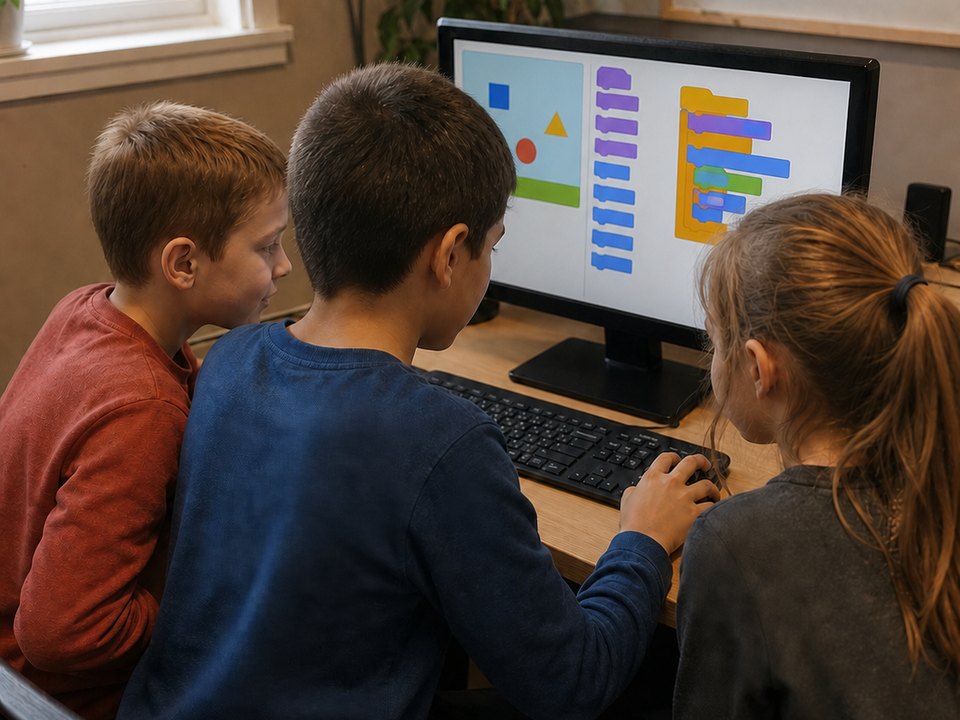
Read the noteScratch makes program structure visible and lets beginners work on logic before punctuation takes over the afternoon.
Read the noteEven a small game brings rules, mathematics, testing, writing, and explanation into one working system.
Read the noteRoblox Studio can connect familiar game ideas to Lua and 3D systems when the curriculum and account safeguards are ready.
Read the noteArticle category
Begin with a clear question about input, decisions, and output. The impressive robot can wait.
Read the noteA sensor turns one physical signal into values. The program and its author decide what those values mean.
Read the noteA microcontroller is a small computer that reads inputs and controls outputs inside a device.
Read the noteRobots make students separate code, measurements, physical parts, and assumptions about the world.
Read the noteArticle category
A safe AI activity has a narrow purpose, non-personal inputs, adult-reviewed tools, and a serious plan for checking errors.
Read the noteA good AI lesson examines what a system produced, what evidence supports it, and which failures repeat.
Read the noteArticle category
The useful question is what a child does at the screen: watch, or make something that can be tested and changed.
Read the noteA suitable starting point depends on the child, the task, and the support available—not one universal birthday.
Read the noteSmall groups let an instructor understand the project in front of each student and give useful help at the right moment.
Read the noteArticle category
Debugging turns ‘it doesn't work’ into a sequence of questions that can actually be answered.
Read the noteA useful project makes an idea testable, gives students consequential choices, and ends with something they can explain.
Read the noteThe Lab gives students time and guidance to change, test, repair, and finish projects across different materials.
Read the noteArticle category
Different tools can deepen the same ideas: events, state, sensing, feedback, testing, and judgment.
Read the noteThe Lab gives students time and guidance to change, test, repair, and finish projects across different materials.
Read the noteArticle category
A suitable starting point depends on the child, the task, and the support available—not one universal birthday.
Read the noteSmall groups let an instructor understand the project in front of each student and give useful help at the right moment.
Read the noteThe Lab gives students time and guidance to change, test, repair, and finish projects across different materials.
Read the noteAsk Eugene about program fit, previous experience, devices, or current availability.